 02 9159 9010

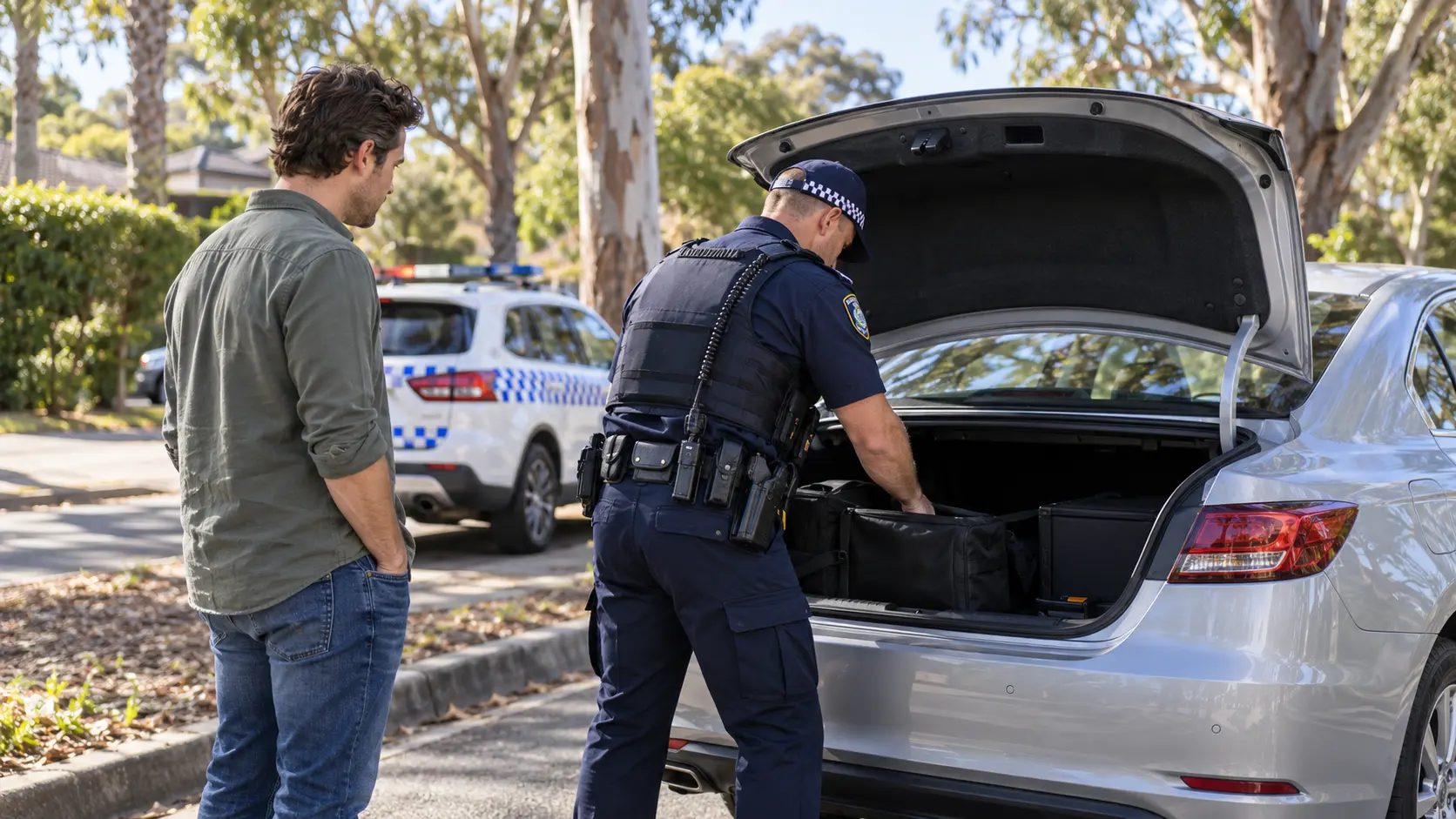
Table of Contents
- Can Police Search Your Car Without a Warrant in NSW?
- The main power: section 36 LEPRA
- Can police pull you over in the first place?
- What police must tell you before searching your car
- Do you have to consent to a police search of your car?
- Sniffer dogs and cars
- Other powers that allow a warrantless car search
- What happens if the search was unlawful?
- What to do if police search your car
- Frequently asked questions
- Charged after a police search of your car?
Can Police Search Your Car Without a Warrant in NSW?
Yes, but only in defined circumstances. Police in New South Wales can stop and search your vehicle without a warrant if they suspect on reasonable grounds that one of the situations set out in section 36 of the Law Enforcement (Powers and Responsibilities) Act 2002 exists. If they do not have that suspicion, the search is unlawful.
That matters more than most people realise. A search that turns up drugs, a weapon or stolen property is not the end of the case. If the search was unlawful, the evidence it produced can be challenged, and sometimes excluded.
The main power: section 36 LEPRA
Section 36(1) of the Law Enforcement (Powers and Responsibilities) Act 2002 (commonly called LEPRA) lets a police officer stop, search and detain a vehicle without a warrant where the officer suspects on reasonable grounds that:
- the vehicle contains, or a person in it has, anything stolen or otherwise unlawfully obtained
- the vehicle was, is being, or may have been used in connection with a relevant offence, or contains anything used or intended to be used in connection with one
- the vehicle is in a public place or school and contains a dangerous article connected with a relevant offence
- the vehicle contains, or a person in it has, a prohibited plant or prohibited drug in breach of the Drug Misuse and Trafficking Act 1985
- circumstances exist on or near a public place or school likely to give rise to a serious risk to public safety, and searching may lessen that risk
Section 20 of LEPRA defines a relevant offence as an indictable offence, an offence against section 93FB of the Crimes Act 1900 (possession of dangerous articles other than firearms in a public place), an offence under the Weapons Prohibition Act 1998 or the Firearms Act 1996, or an offence under Part 2 of the Explosives Act 2003.
The drug ground is broader than the others. It is not confined to supply or cultivation. A reasonable suspicion of simple possession is enough to enliven the power. Section 36(3) then lets police seize what the search turns up.
What “reasonable suspicion” actually means
The leading NSW authority is R v Rondo [2001] NSWCCA 540, itself a car search case. Smart AJ set out propositions courts still apply.
- A reasonable suspicion sits below a reasonable belief but above a mere possibility.
- It cannot be arbitrary. There must be some factual basis for it, with some probative value.
- What counts is the information actually in the officer’s mind when they stopped the vehicle, not what the search later produced.
That last point does a lot of work. Police cannot work backwards and justify a search by pointing at what they found. A driver simply looking nervous in a high crime area has been held insufficient.
Can police pull you over in the first place?
Stopping and searching are two different powers. Section 36A of LEPRA lets police stop a vehicle where they suspect on reasonable grounds that the driver or a passenger is someone they have grounds to arrest, detain or search.
Separately, road transport law lets police stop drivers for licence checks and random breath testing. Section 175 of the Road Transport Act 2013 lets an authorised officer require a driver to produce their licence and state their name and home address. Refusing, or giving false details, carries a maximum penalty of 20 penalty units.
A lawful stop is not a lawful search. Being pulled over for a random breath test gives police no power on its own to go through your boot, glovebox or bag.
What police must tell you before searching your car
Part 15 of LEPRA sets out safeguards, and section 201 confirms they apply to stopping or searching a vehicle. Under section 202, the officer must provide:
- Evidence that they are a police officer, unless they are in uniform
- Their name and place of duty
- The reason for exercising the power
If several officers are involved, only one needs to do this. Section 204A softens the rule: a failure to give a name or place of duty does not by itself make the search unlawful, unless you asked and were refused. A failure to explain the reason sits outside that protection and is more likely to trouble the prosecution. So ask, once, calmly, and remember the answers.
Do you have to consent to a police search of your car?
No. You are not required to consent.
Section 34A of LEPRA governs consent searches of a person. There is no equivalent for vehicles, because if police genuinely hold the suspicion section 36 requires, they do not need your permission.
Consent matters for a different reason. Agree to the search and you give away the argument about whether the suspicion was reasonable. Saying plainly that you do not consent preserves that argument for court. It does not entitle you to physically prevent the search. If police search anyway, let them. Hindering or resisting police is a separate offence.
Sniffer dogs and cars
Police often walk a drug detection dog around a stopped vehicle. The rules here are narrower than most people assume.
Section 148 of LEPRA permits general drug detection using dogs without a warrant, but only in listed settings: licensed premises, public events such as concerts and sporting fixtures, prescribed public transport routes and stations, tattoo premises, the Kings Cross precinct, and premises entered under the Restricted Premises Act 1943. A car stopped on a suburban street is not on that list. Section 146 lets an officer already authorised to search a person for a drug offence use a dog for that purpose, and section 149 allows dog-based detection in a public place under warrant.
The dog does not create a power that would not otherwise exist. Whether a dog’s indication amounts to reasonable suspicion is argued in Local Courts regularly and turns on the facts, including the dog’s handling and reliability.
Other powers that allow a warrantless car search
Police can also obtain a warrant covering a vehicle, and further search powers follow a lawful arrest. Two other powers come up often:
- Section 37 of LEPRA lets a senior officer authorise a roadblock where a vehicle or class of vehicles is reasonably suspected of being connected to an indictable offence, or where there is a serious risk to public safety.
- Firearms prohibition orders. Section 74A of the Firearms Act 1996 lets police stop, detain and search any vehicle occupied by or under the control of a person subject to an FPO, looking for firearms, firearm parts or ammunition. No reasonable suspicion is required.
What happens if the search was unlawful?
The evidence does not vanish automatically. NSW has no automatic exclusion rule. What you have is section 138 of the Evidence Act 1995 (NSW). Evidence obtained improperly, or in breach of Australian law, is not to be admitted unless the court decides the desirability of admitting it outweighs the undesirability of admitting evidence obtained that way. Section 138(3) lists what the court weighs, including the value of the evidence, its importance to the case, the seriousness of the charge, how serious the breach was, and whether it was deliberate or reckless.
In the Local Court this is usually run as a voir dire. The officer gives evidence about what was in their mind when they decided to search, and the magistrate rules. Where the drugs or the weapon are the whole prosecution case, exclusion often ends the matter.
What to do if police search your car
- Do not obstruct the search, even if you think it is unlawful.
- Say clearly, out loud, that you do not consent.
- Ask for the officer’s name, station and reason for the search.
- Beyond your name, address and licence, do not answer questions about what is in the car.
- Write it all down as soon as you can: time, location, what was said, how many officers, whether a dog was used.
- Get advice before your first court date, not after it.
Frequently asked questions
Can police search my car during a random breath test?
Not on that basis alone. Breath testing and searching a vehicle come from different powers. Police need a separate reasonable suspicion under section 36 of LEPRA before searching the car.
Do police have to tell me why they are searching my car?
Yes. Section 202 of LEPRA requires the officer to give the reason, along with their name and place of duty. If they refuse, note it down. It can matter later.
What happens if I refuse to let police search my car?
Refusing consent is not an offence and it should be recorded on body-worn video. If police believe they have the power under section 36, they can search anyway. Physically interfering with them is a separate offence.
Charged after a police search of your car?
Whether a search was lawful comes down to what the officer knew and when, and that is worth examining before you plead to anything. Blackridge Law appears in Local Courts across Sydney every week. Call us on 02 9159 9010 to talk through your situation.
This article is general information only and is not legal advice. The law changes, and every case turns on its own facts. Speak to a lawyer about your specific circumstances.